CASE STUDY

Governed Lending Decisions

Exploring how AI-assisted lending can turn messy loan documents into governed evidence, traceable answers, and decision-ready context.

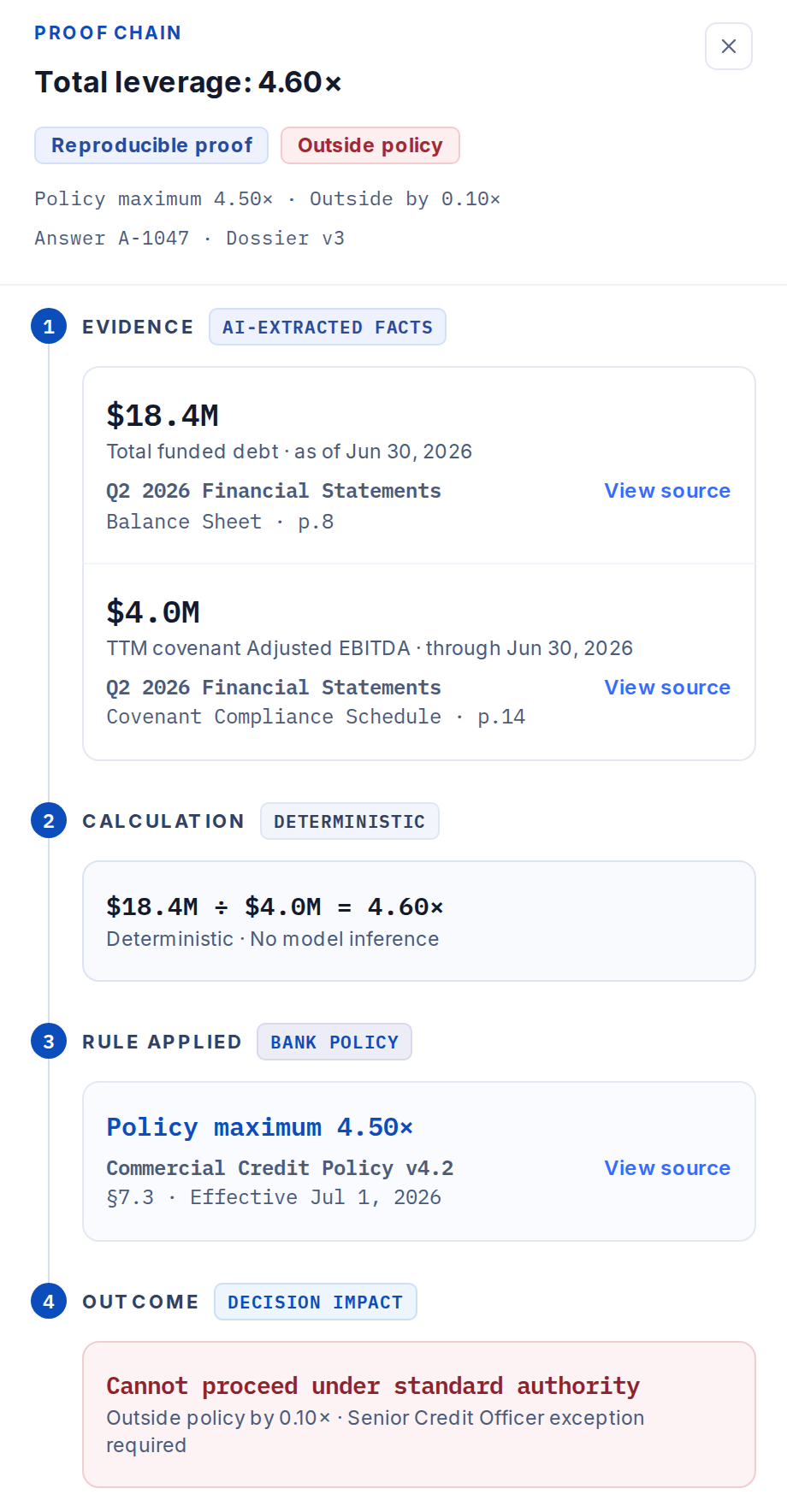
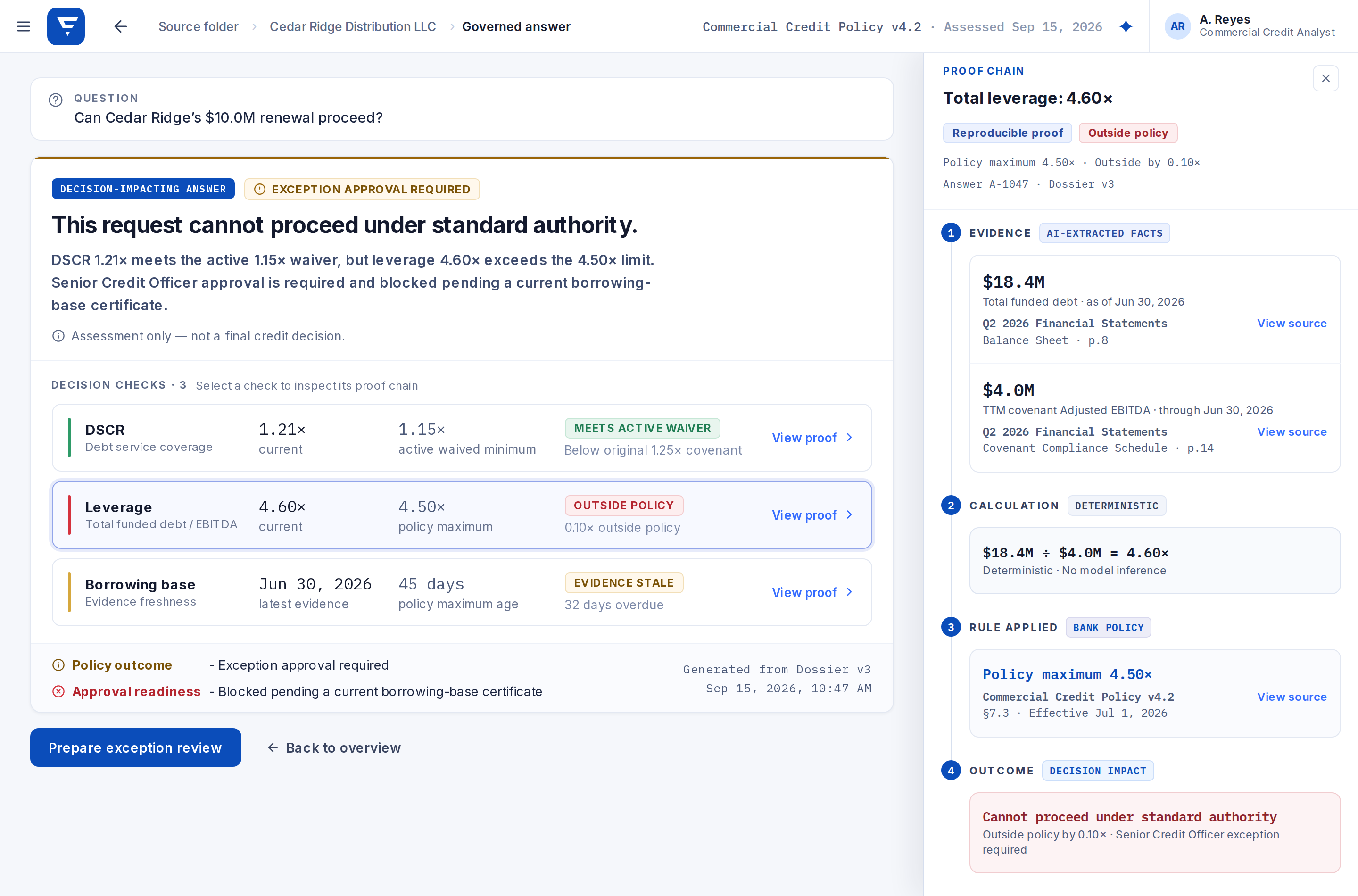
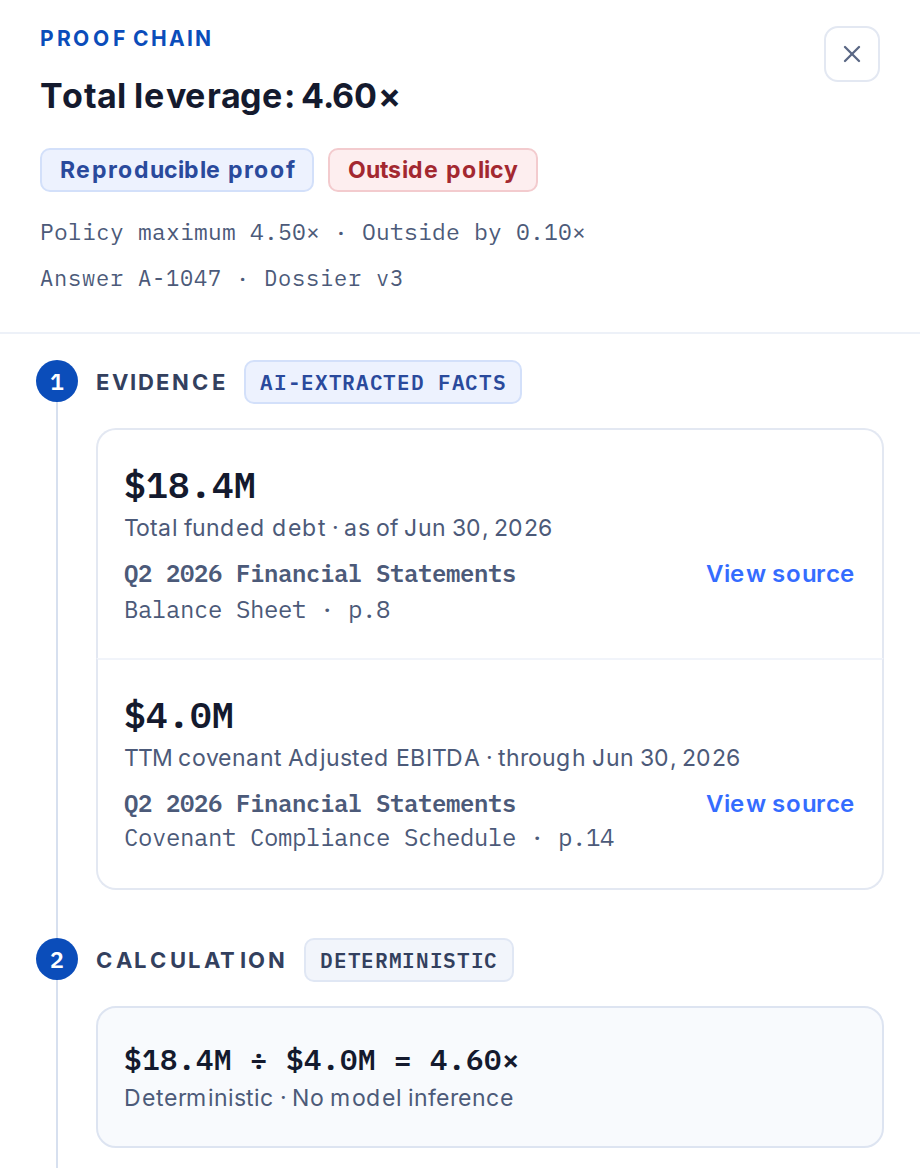
Factify concept, Governed Answer with Proof Lens open: the answer states the $10.0M renewal cannot proceed under standard authority, with DSCR, Leverage and Borrowing base decision checks; the Proof Chain for total leverage 4.60× shows evidence ($18.4M total funded debt, $4.0M TTM covenant Adjusted EBITDA), the deterministic calculation, the bank policy rule (maximum 4.50×) and the outcome Proof Chain, mobile crop: total leverage 4.60×, marked reproducible proof and outside policy, with the evidence facts and the deterministic calculation $18.4M ÷ $4.0M = 4.60×
ROLE
Product Designer
DOMAIN
Commercial Lending · AI Governance
FOCUS
Trust · Governance · Decision Support
SCOPE
Product Framing · UX · UI · Interactive Prototype
PROJECT
Factify
PROJECT TYPE
Internal Concept · Product Exploration

01

CONTEXT

AI can produce an answer long before a credit team can trust it.

This internal concept project explored how a commercial lending workflow could move from fragmented loan documents to a governed, decision-ready object.

Lending decisions depend on information spread across agreements, financial statements, covenant schedules, waivers, certificates, and previous approvals. Extracting that information is not enough: the system also needs to establish which source is authoritative, whether the evidence is current, which policy applies, and what happens when those signals disagree.

The goal was to make the trust model, exception handling, and evidence chain concrete enough for internal discussion.

The central question became:

What would it take for an AI-generated answer to be inspectable, reproducible, and defensible?

02

THE CHALLENGE

Trust cannot be reduced to a “verified” badge.

A lending answer can look correct while still being unsafe to use.

Sources can conflict, become stale, or carry unclear authority. Policy can change the meaning of otherwise valid evidence, and even a correct calculation may still require a human decision.

The concept therefore needed to answer more than:

“What is the answer?”

  • Which evidence governs?

  • Is that evidence current enough for this decision?

  • Which rule or policy produced the result?

  • What was calculated by the system, and what still requires human judgment?

  • Who has authority when the normal path cannot proceed?

The design problem became one of making the entire trust chain visible rather than presenting a confident answer in isolation.

03

RESEARCH

Defining what trust has to mean in the interface.

The research was primarily desk-based.

I reviewed Factify’s public product framing, adjacent AI-governance patterns, and broader governance and risk frameworks to understand authority, policy, provenance, auditability, and human intervention in consequential AI workflows.

The research shaped the concept and the questions it should surface. Workflow validation was outside the scope of this exploration.

What I needed to understand

  1. 01

    What makes information trustworthy enough to act on?

    How do authority, version, provenance, freshness, and policy affect whether a source can be used?

  2. 02

    Where should automation stop and human authority begin?

    What can the system determine, and where must consequential judgment remain human?

  3. 03

    How should a decision be explained without overwhelming the user?

    How can the conclusion stay clear while evidence, calculation, rule, and source remain inspectable?

Principles that shaped the concept

  1. 01

    Trust by evidence, not labels

    Expose source, authority, version, freshness, and governing rule when they affect the decision.

  2. 02

    Policy before action

    Show what will be blocked, permitted, or escalated before an irreversible action.

  3. 03

    Human authority must remain explicit

    Make clear who can decide and what is required before they act.

  4. 04

    Version and freshness are different dimensions

    An authoritative source can still be too old for the current decision.

  5. 05

    Audit should read like a decision story

    Let a reviewer reconstruct the reasoning path without digging through a technical event log.

RESEARCH DIRECTION

FROM

AI answer + citations

TO

Source → Authority → Policy → Proof → Human action

Trust is a chain, not a score.

04

KEY PRODUCT DECISIONS

The concept was structured around making every break in the trust chain visible.

DECISION 01

Make source authority a human decision before governance

PROBLEM

The source folder contained conflicting versions of the same financial fact.

One document was a draft workbook; the other was a signed final PDF.

A filename such as “FINAL” is useful context, but it should not automatically define authority.

DECISION

I introduced a dedicated Review before governing step.

The concept identifies the conflict but explicitly states:

“Factify does not select an authoritative source on your behalf.”

The reviewer compares both source documents, opens the underlying source if needed, and confirms which document should govern.

The selection is then recorded as part of the audit trail.

RATIONALE

The concept separates ambiguity detection from authority.

Automation can identify the problem. Human judgment establishes the source of truth.
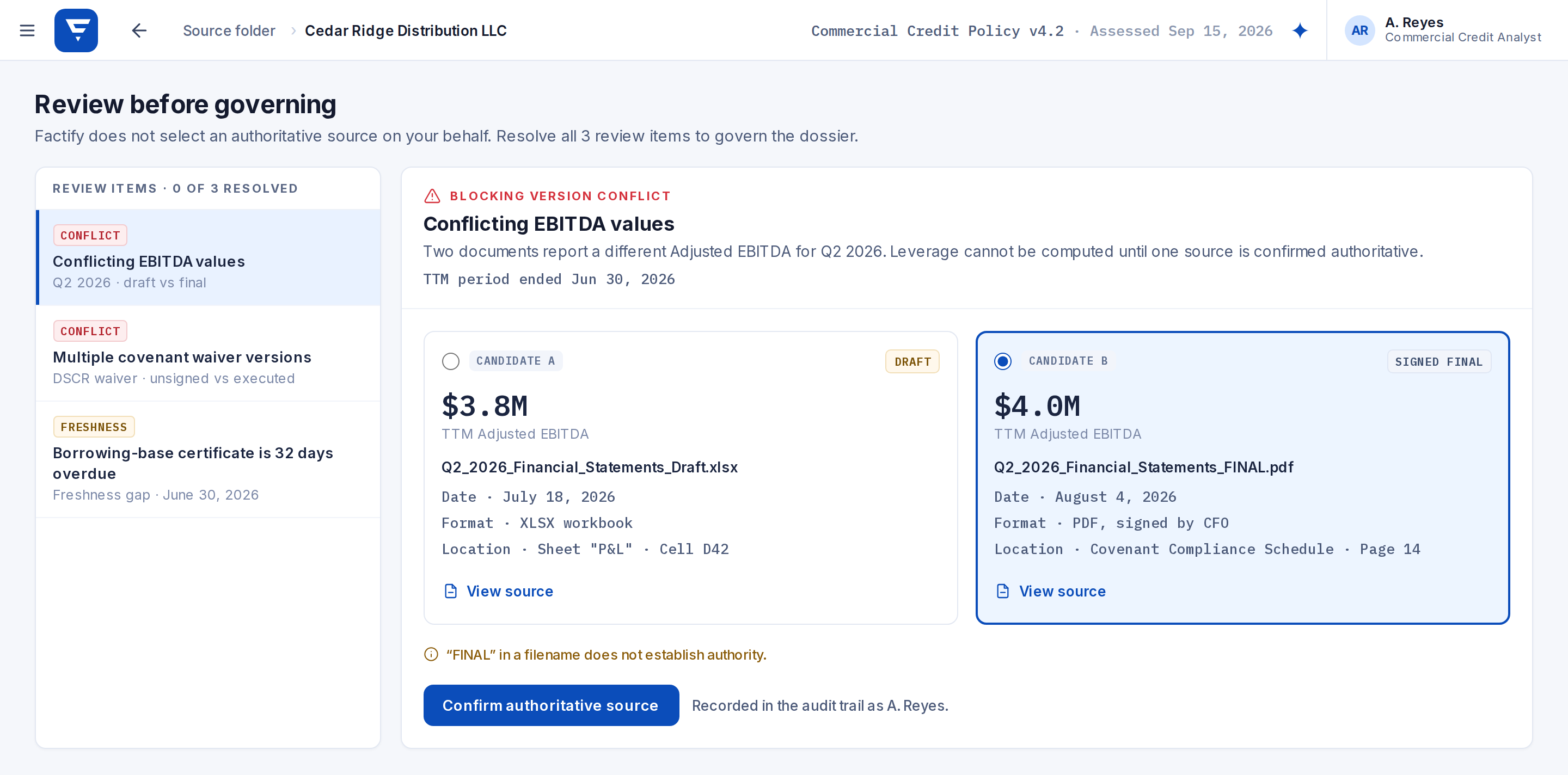
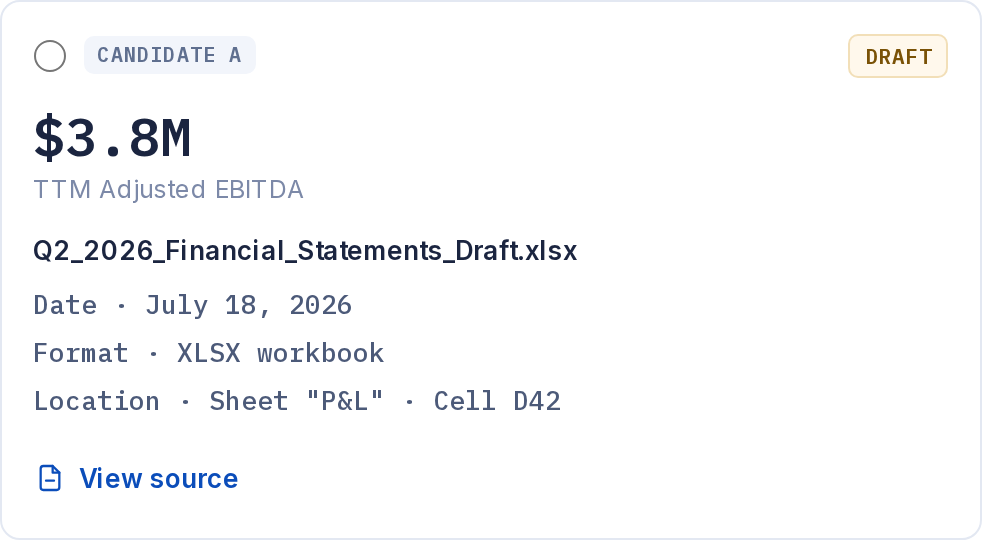
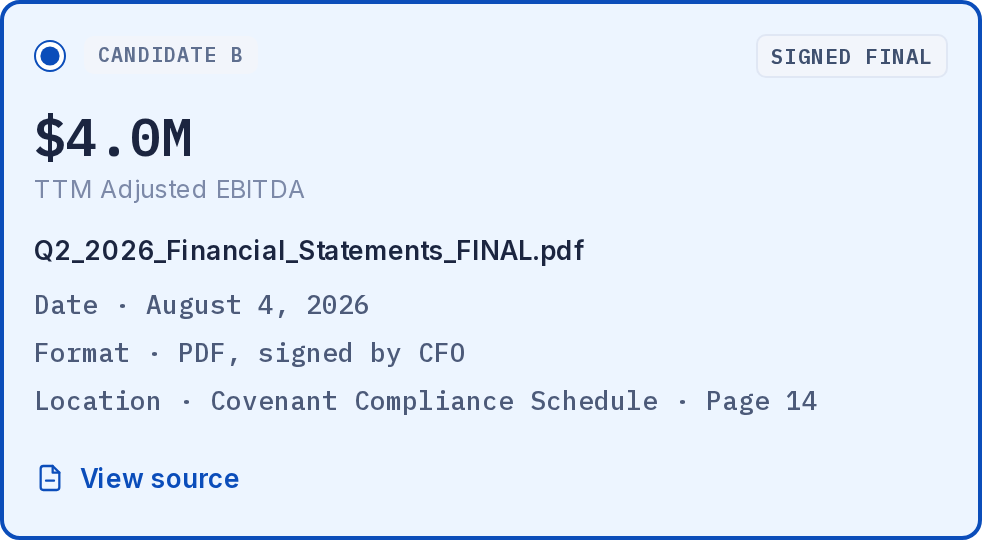
Review before governing, Conflicting EBITDA values: $3.8M TTM Adjusted EBITDA from the draft XLSX workbook beside $4.0M from the CFO-signed final PDF, which is selected; a note that “FINAL” in a filename does not establish authority, and a Confirm authoritative source action recorded in the audit trail
Draft source option: $3.8M TTM Adjusted EBITDA, Q2_2026_Financial_Statements_Draft.xlsx, July 18, 2026, XLSX workbook, Sheet P&L cell D42 Signed final source option, selected: $4.0M TTM Adjusted EBITDA, Q2_2026_Financial_Statements_FINAL.pdf, August 4, 2026, PDF signed by CFO, Covenant Compliance Schedule page 14

DECISION 02

Treat freshness as a different problem from authority

PROBLEM

A document can still be authoritative for its reporting period and yet be too old for the current decision.

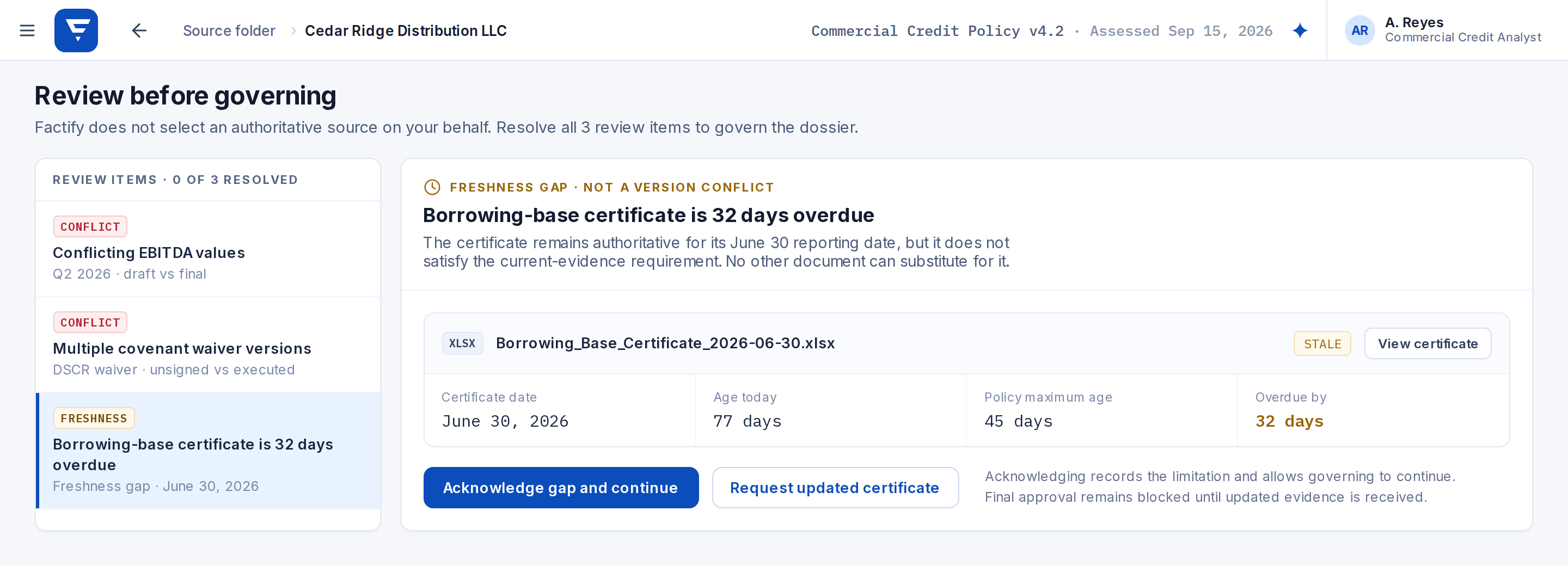
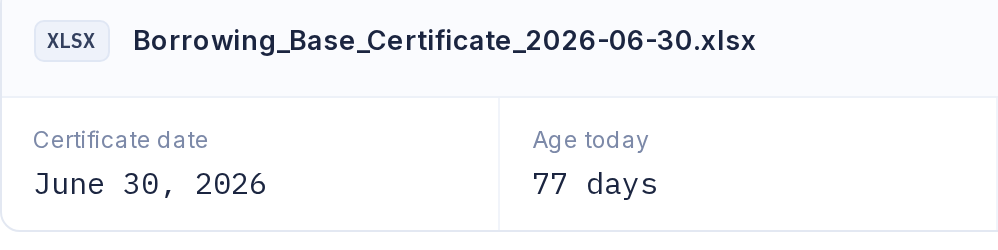
The borrowing-base certificate was still authoritative for its reporting date, but it was 77 days old against a 45-day policy maximum.

Replacing it with another source would not solve the problem because no other document substitutes for it.

DECISION

I modeled this explicitly as a Freshness gap, not another version conflict.

The concept provides two paths:

Request updated certificate

or

Acknowledge gap and continue

If the reviewer continues, the limitation remains attached to the dossier and audit trail, while final approval remains blocked until current evidence is available.

RATIONALE

“Authoritative” and “current enough for this decision” are different properties.

Keeping them separate prevents stale evidence from becoming either falsely trusted or incorrectly discarded.

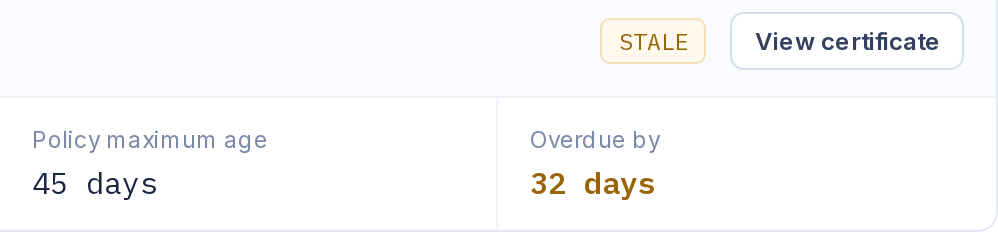
Review before governing, Freshness gap, not a version conflict: Borrowing_Base_Certificate_2026-06-30.xlsx marked stale, certificate date June 30, 2026, age today 77 days, policy maximum age 45 days, overdue by 32 days, with Acknowledge gap and continue and Request updated certificate actions
Borrowing-base certificate: certificate date June 30, 2026, age today 77 days Borrowing-base certificate: policy maximum age 45 days, overdue by 32 days, marked stale

DECISION 03

Separate object integrity from decision readiness

PROBLEM

Resolving document conflicts does not mean that every business decision can now proceed.

A dossier can be internally coherent while the requested action still violates policy or depends on missing evidence.

DECISION

I separated two concepts:

Object integrity — Governed v3

and

Decision readiness — Decision check required

The governed dossier creates a stable source of truth while preserving source authority, evidence gaps, and audit history.

RATIONALE

Governance answers:

“Do we know what information governs this object?”

Decision readiness answers:

“Can this specific action proceed under the current evidence and policy?”

Those are different product questions and should not collapse into one status.

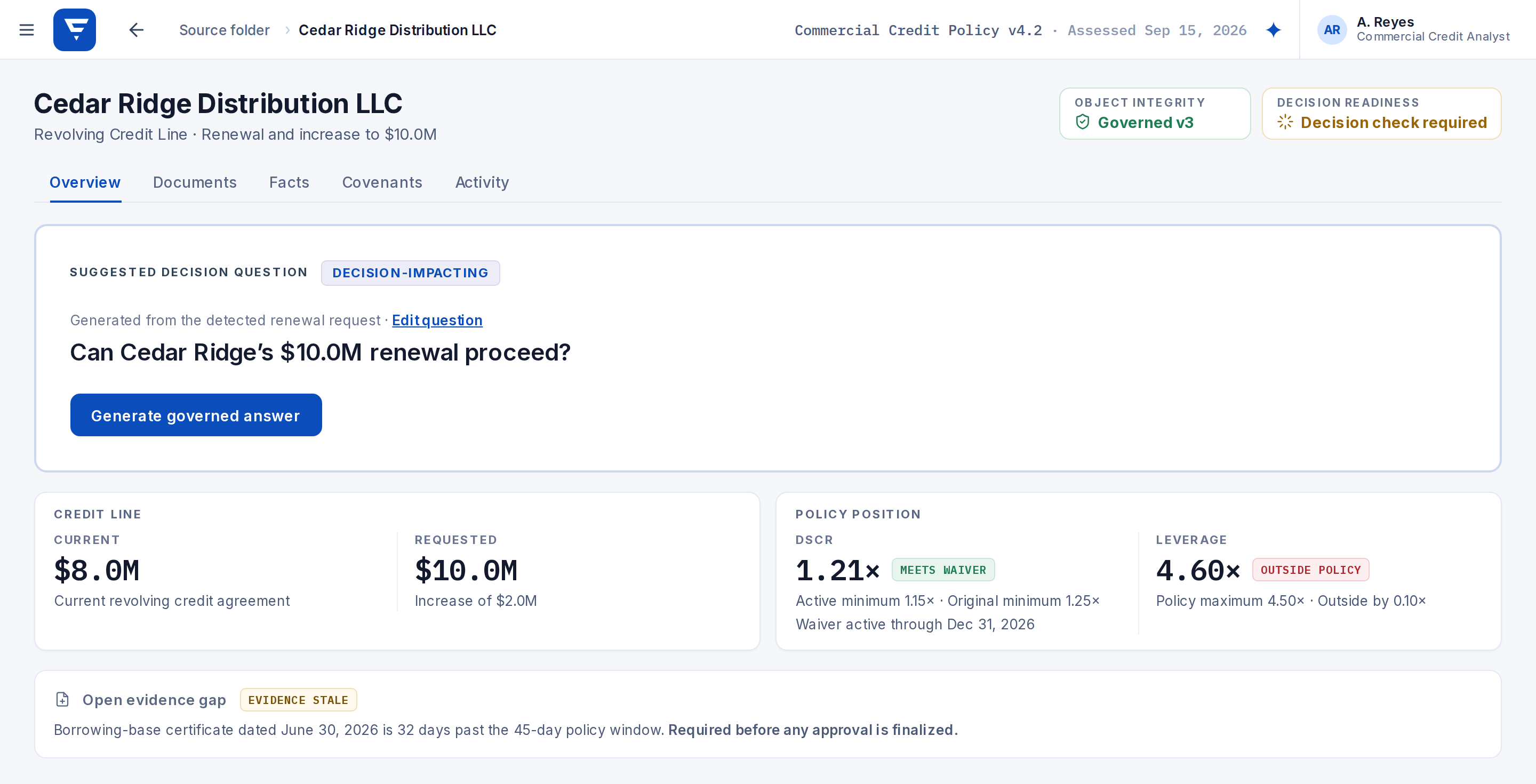
Governed dossier for Cedar Ridge Distribution LLC: Object integrity Governed v3 beside Decision readiness Decision check required; Overview, Documents, Facts, Covenants and Activity tabs; a suggested decision-impacting question; credit line current $8.0M and requested $10.0M; policy position with DSCR 1.21× meeting the waiver and leverage 4.60× outside policy; and an open evidence gap for the stale borrowing-base certificate
Object integrity Governed v3 and Decision readiness Decision check required
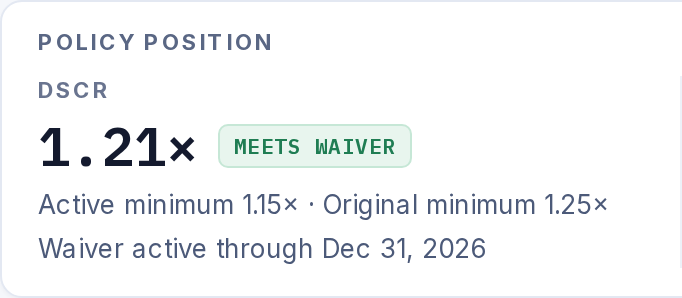
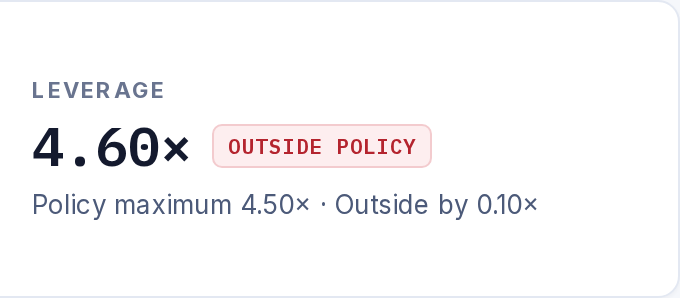
Policy position, DSCR: 1.21×, meets waiver; active minimum 1.15×, original minimum 1.25×, waiver active through Dec 31, 2026 Policy position, Leverage: 4.60×, outside policy; policy maximum 4.50×, outside by 0.10×

DECISION 04

Make proof reproduce the answer, not decorate it

PROBLEM

A source link beside an AI answer provides provenance, but it does not explain how the source became the conclusion.

For a consequential lending decision, the reviewer needs to understand the transformation.

DECISION

I designed a Proof Chain with four layers:

  1. 01EvidenceThe source facts used by the system.
  2. 02CalculationThe deterministic transformation of those facts.
  3. 03Rule appliedThe governing loan term or bank policy.
  4. 04OutcomeThe decision impact produced by that rule.

Each source remains directly accessible from the chain.

RATIONALE

The proof becomes reproducible rather than merely referential.

The interface does not ask the reviewer to trust the explanation. It exposes the evidence and logic required to verify it.

Proof Lens, Proof Chain for total leverage 4.60×, marked reproducible proof and outside policy: 01 Evidence, AI-extracted facts $18.4M total funded debt (Q2 2026 Financial Statements, Balance Sheet p.8) and $4.0M TTM covenant Adjusted EBITDA (Covenant Compliance Schedule p.14), each with View source; 02 Calculation, deterministic, $18.4M ÷ $4.0M = 4.60×, no model inference; 03 Rule applied, bank policy maximum 4.50× from Commercial Credit Policy v4.2 §7.3; 04 Outcome, cannot proceed under standard authority, Senior Credit Officer exception required
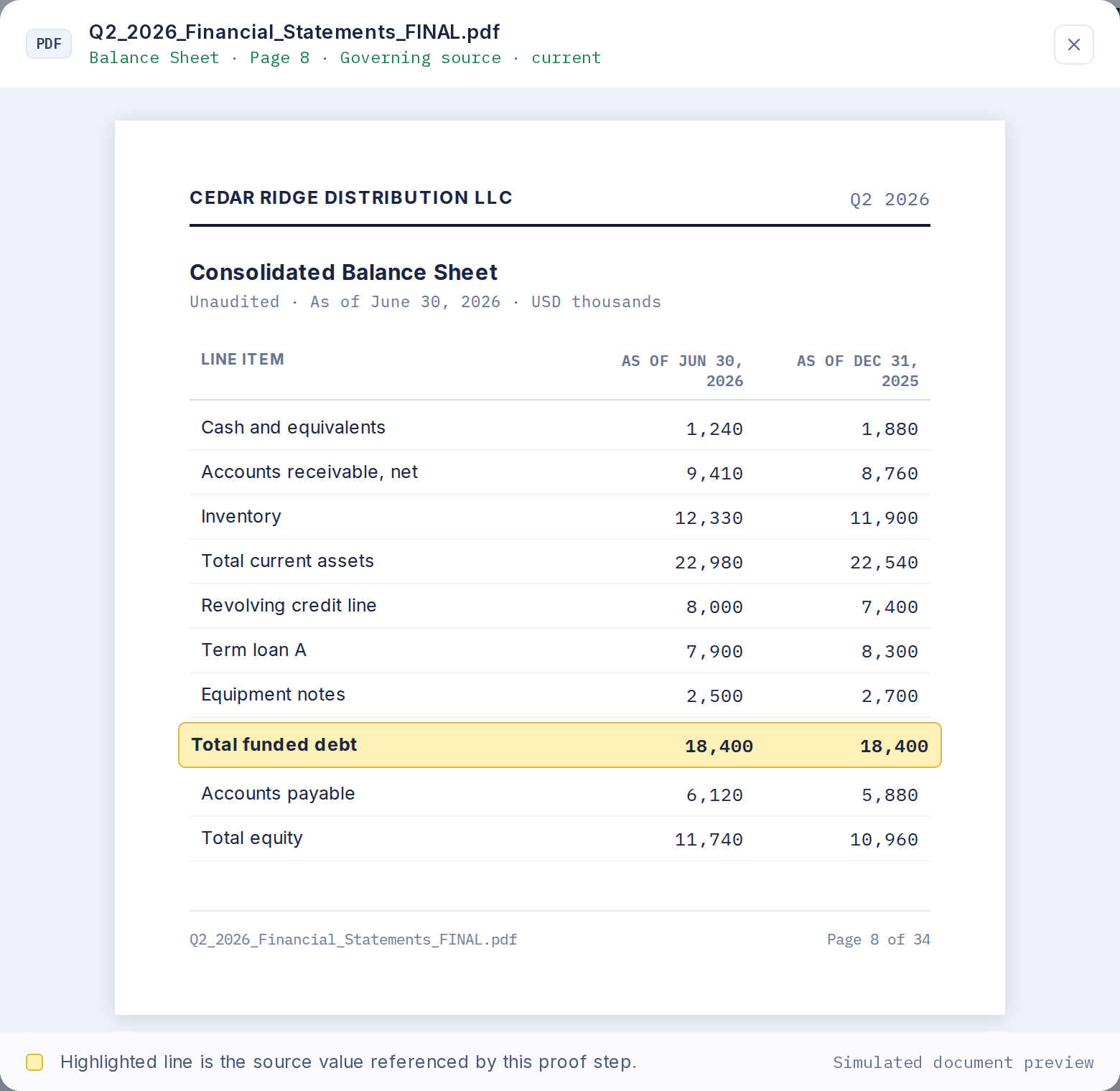
Trace to source from the proof: Q2_2026_Financial_Statements_FINAL.pdf, Balance Sheet page 8, governing source, with the Total funded debt line of 18,400 highlighted as the value referenced by the proof step

DECISION 05

Preserve human authority when the standard path fails

PROBLEM

A policy failure should not become either a dead end or an AI-generated override.

In this scenario, the evidence supports some conditions while others fall outside policy or remain incomplete.

A simple approved / rejected state would hide too much of the decision.

DECISION

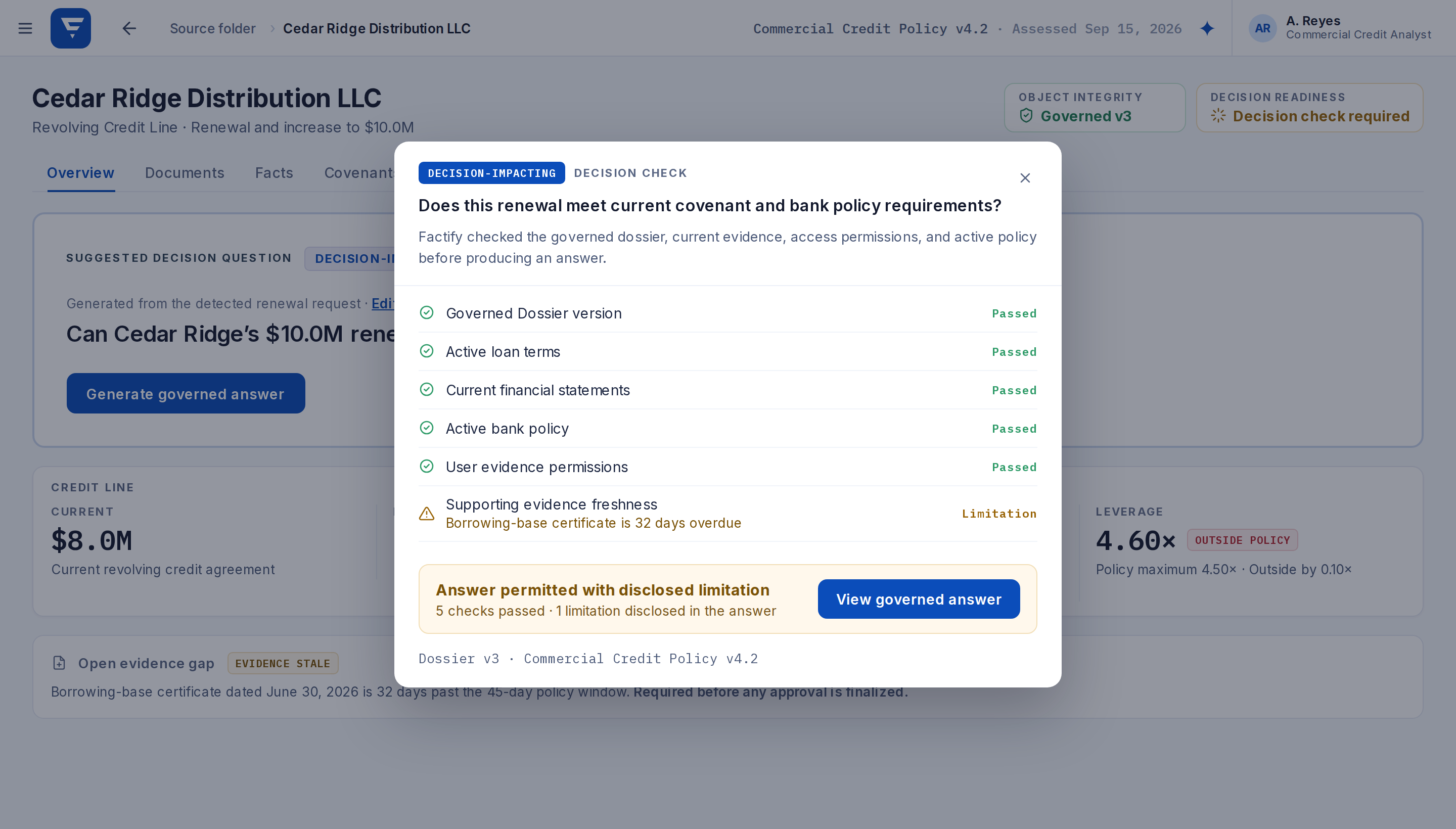
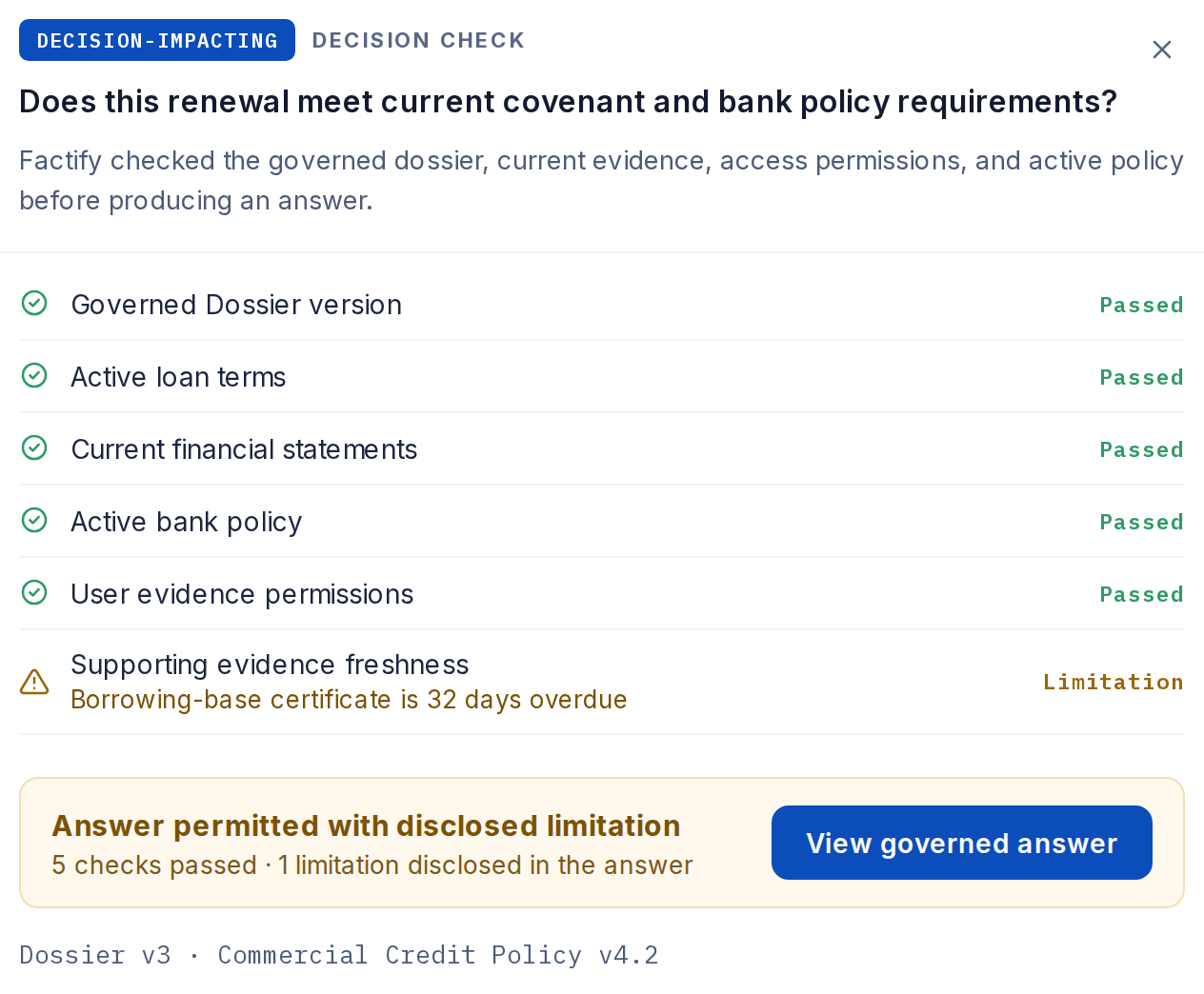
I introduced a Decision Check that evaluates the governed dossier against current evidence, loan terms, policy, permissions, and freshness.

The Governed Answer separates what meets policy, what does not, what evidence is missing or stale, and what approval is required before moving into Exception Review.

RATIONALE

The system can assemble the decision context and explain the constraint.

The authority to make an exception remains with the person empowered to do so.

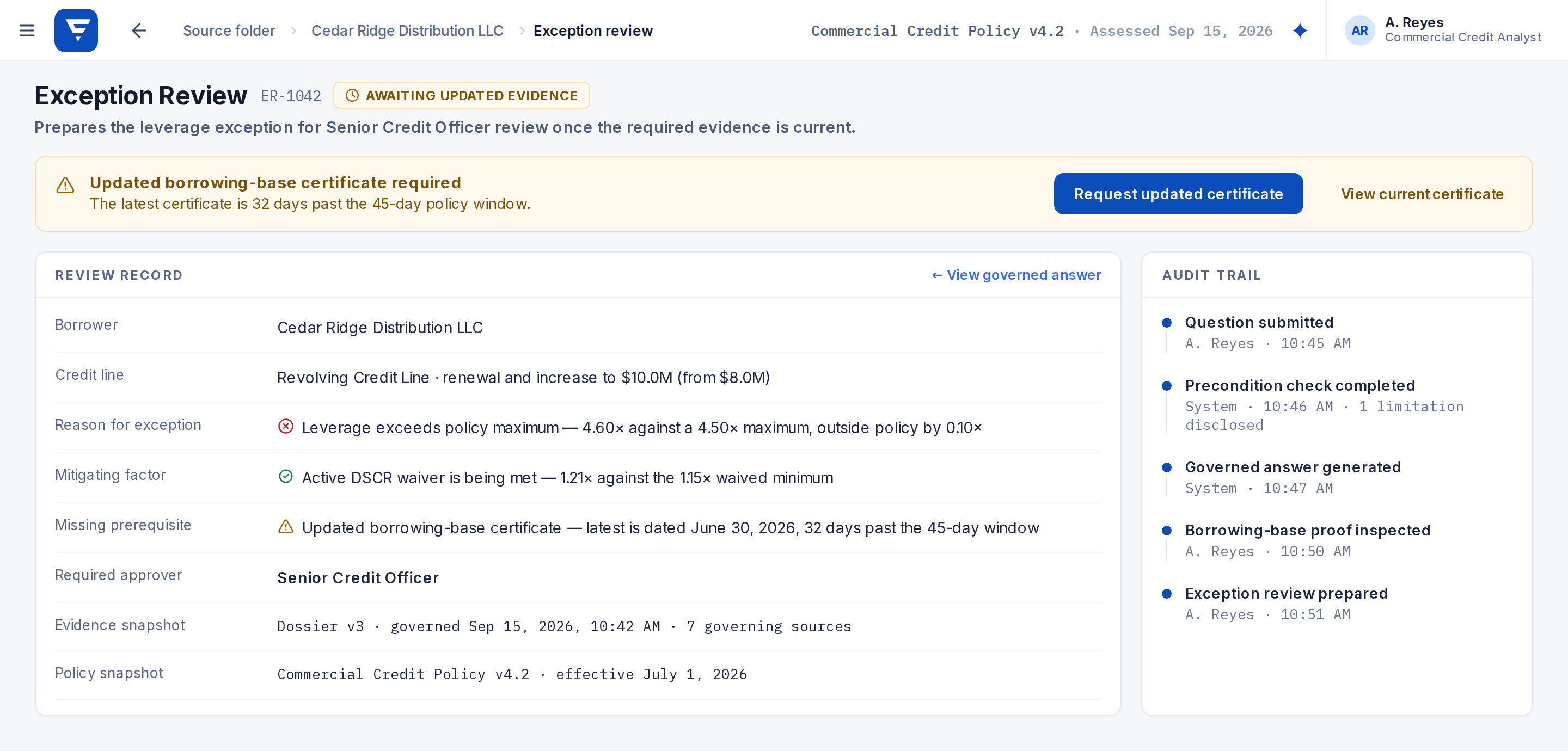
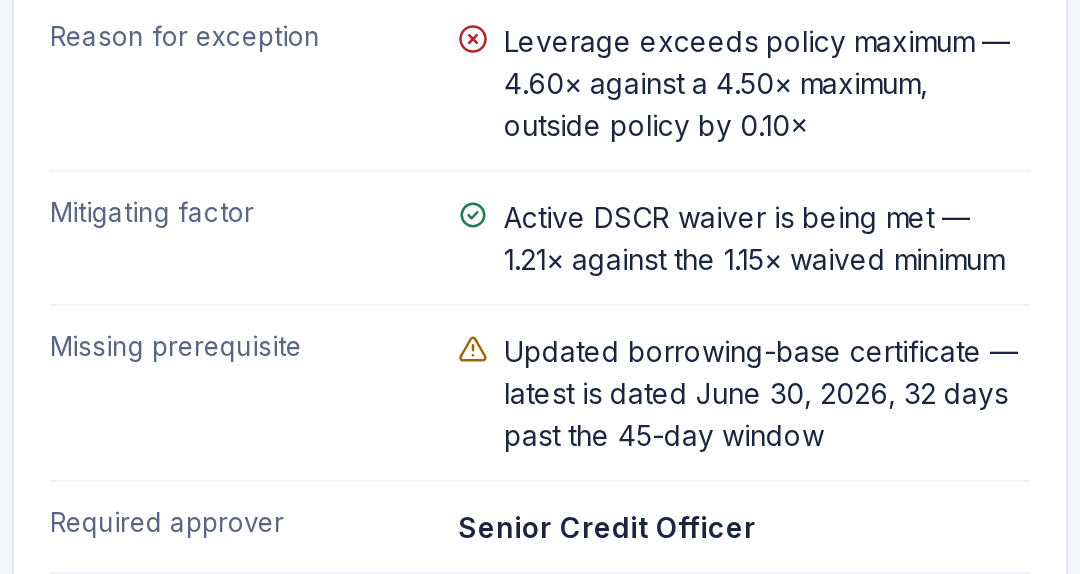
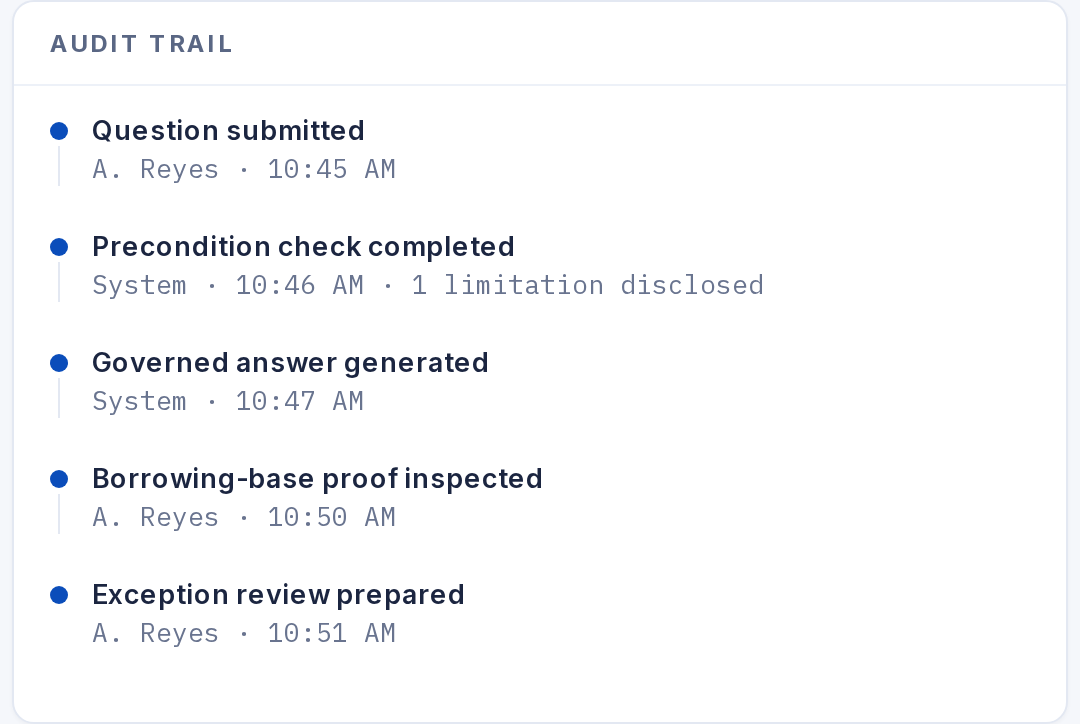
Decision Check dialog for the question “Does this renewal meet current covenant and bank policy requirements?”: governed dossier version, active loan terms, current financial statements, active bank policy and user evidence permissions passed; supporting evidence freshness flagged as a limitation because the borrowing-base certificate is 32 days overdue; answer permitted with disclosed limitation, 5 checks passed and 1 limitation disclosed Decision Check dialog, mobile crop: governed dossier version, active loan terms, current financial statements, active bank policy and user evidence permissions passed; supporting evidence freshness flagged as a limitation because the borrowing-base certificate is 32 days overdue; answer permitted with disclosed limitation Exception Review ER-1042, awaiting updated evidence: an updated borrowing-base certificate is required; the review record lists the borrower, credit line, reason for exception (leverage 4.60× against a 4.50× maximum), mitigating factor (active DSCR waiver met), missing prerequisite, required approver Senior Credit Officer, and evidence and policy snapshots, beside an audit trail from question submitted to exception review prepared
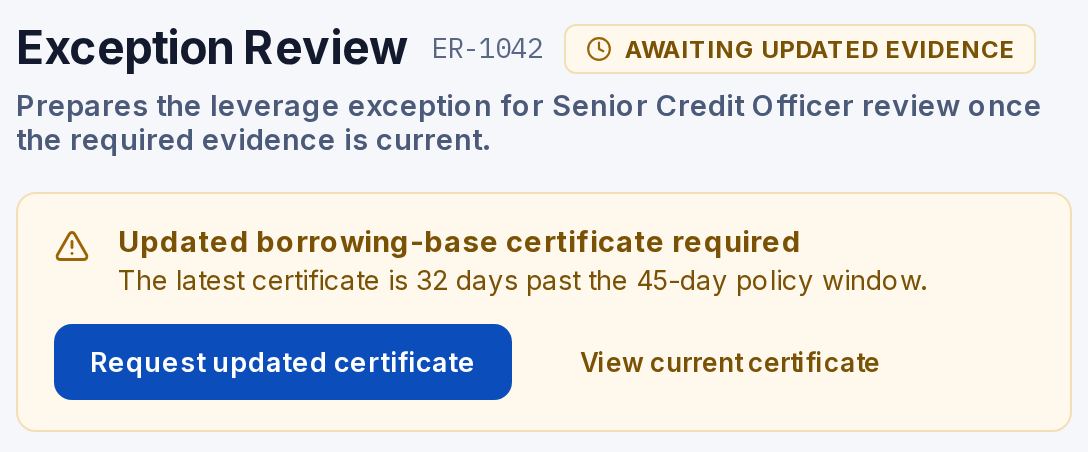
Exception Review ER-1042, awaiting updated evidence: updated borrowing-base certificate required, the latest certificate is 32 days past the 45-day policy window, with Request updated certificate and View current certificate actions Exception Review record: reason for exception, leverage exceeds policy maximum at 4.60× against a 4.50× maximum; mitigating factor, active DSCR waiver met at 1.21× against 1.15×; missing prerequisite, updated borrowing-base certificate; required approver, Senior Credit Officer Exception Review audit trail: question submitted, precondition check completed with 1 limitation disclosed, governed answer generated, borrowing-base proof inspected, exception review prepared

05

THE EXPERIENCE

From raw documents to a decision someone can defend.

  1. 01Ingest
  2. 02Resolve
  3. 03Govern
  4. 04Prove
  5. 05Escalate

01INGEST

Turn the folder into a review-ready dossier.

The concept begins with the source material.

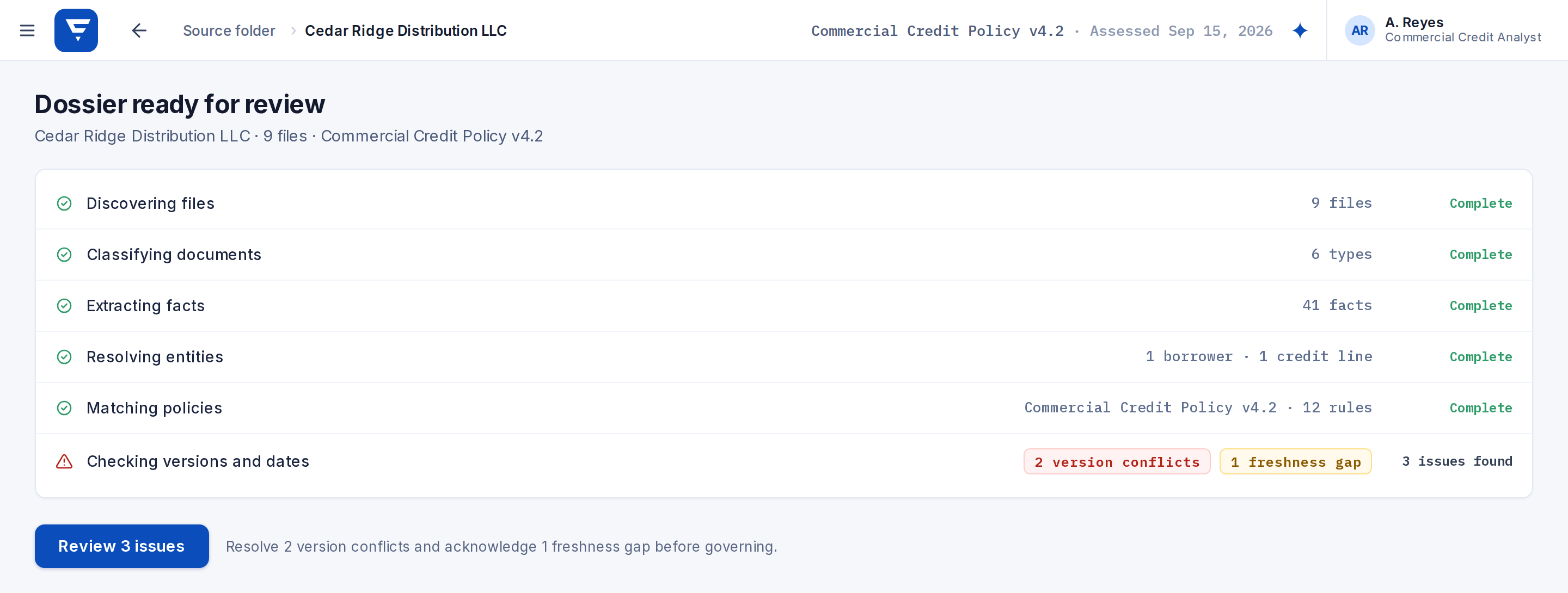
The connected folder preserves origin, permissions, timestamps, document types, and filenames while the system classifies documents, extracts facts, resolves entities, matches policy, and checks versions and dates.

The result is review-ready, not yet trusted: conflicts and freshness gaps are surfaced before governance.

Building the loan dossier: discovering files (9 files), classifying documents (6 types), extracting facts (41 facts), resolving entities (1 borrower, 1 credit line), matching policies (Commercial Credit Policy v4.2, 12 rules) all complete, and checking versions and dates finding 2 version conflicts and 1 freshness gap, with a Review 3 issues action
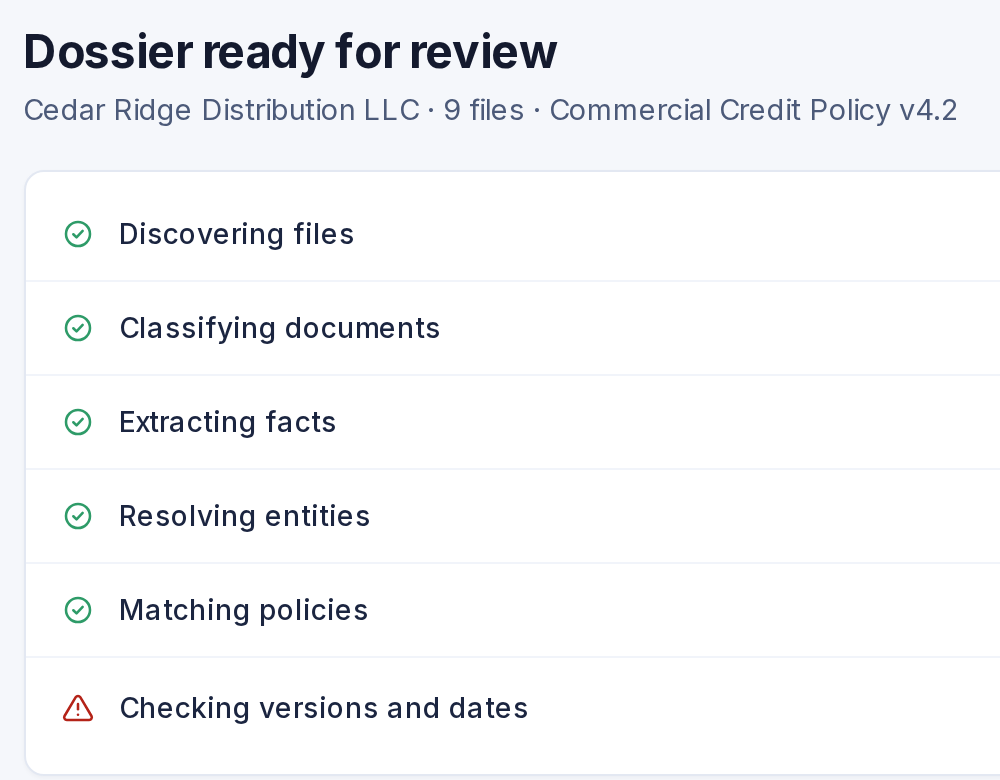
Dossier ready for review, mobile crop: Cedar Ridge Distribution LLC, 9 files, Commercial Credit Policy v4.2; discovering files, classifying documents, extracting facts, resolving entities, matching policies, and checking versions and dates Checking versions and dates: 2 version conflicts, 1 freshness gap, 3 issues found

02RESOLVE

Make uncertainty explicit before it becomes fact.

The Review flow concentrates the issues that block governance: conflicting EBITDA values, multiple waiver versions, and stale borrowing-base evidence.

The interface explains why each issue matters, links directly to source, and records the reviewer’s authority decisions and acknowledged limitations.

03GOVERN

Create a stable object without pretending every decision is ready.

Once review is complete, the concept creates a governed dossier with explicit governing and superseded sources.

Documents, facts, covenants, evidence gaps, and activity remain connected, separating a stable source of truth from readiness for a specific lending decision.

04PROVE

Let the user move from conclusion back to evidence.

The Decision Check evaluates the conditions behind the answer.

Governed Answer summarizes the decision position; Proof Lens reveals:

Evidence → Calculation → Rule → Outcome

and lets the reviewer trace the result back to source.

05ESCALATE

Keep exceptions inside the governed flow.

When standard authority is insufficient, the workflow moves into Exception Review with the decision context, missing evidence, required approver, and audit history attached.

The user can request what is missing without losing the decision record or the path that produced it.

From confident answers to accountable decisions.

This project explored what AI trust could look like when governance is part of the product experience rather than metadata around the answer.

The concept connects source authority, freshness, policy, proof, and human authority into one continuous decision model.

It made difficult product questions concrete enough to discuss, critique, and evolve.

Know which source governs.

See why the answer holds.

Keep humans in control of the decision.